Laccase Enzyme Assay for Wastewater Treatment Validation
Practical laccase enzyme assay guidance for wastewater trials, QC, dosing, COA review, supplier qualification, and cost-in-use validation.
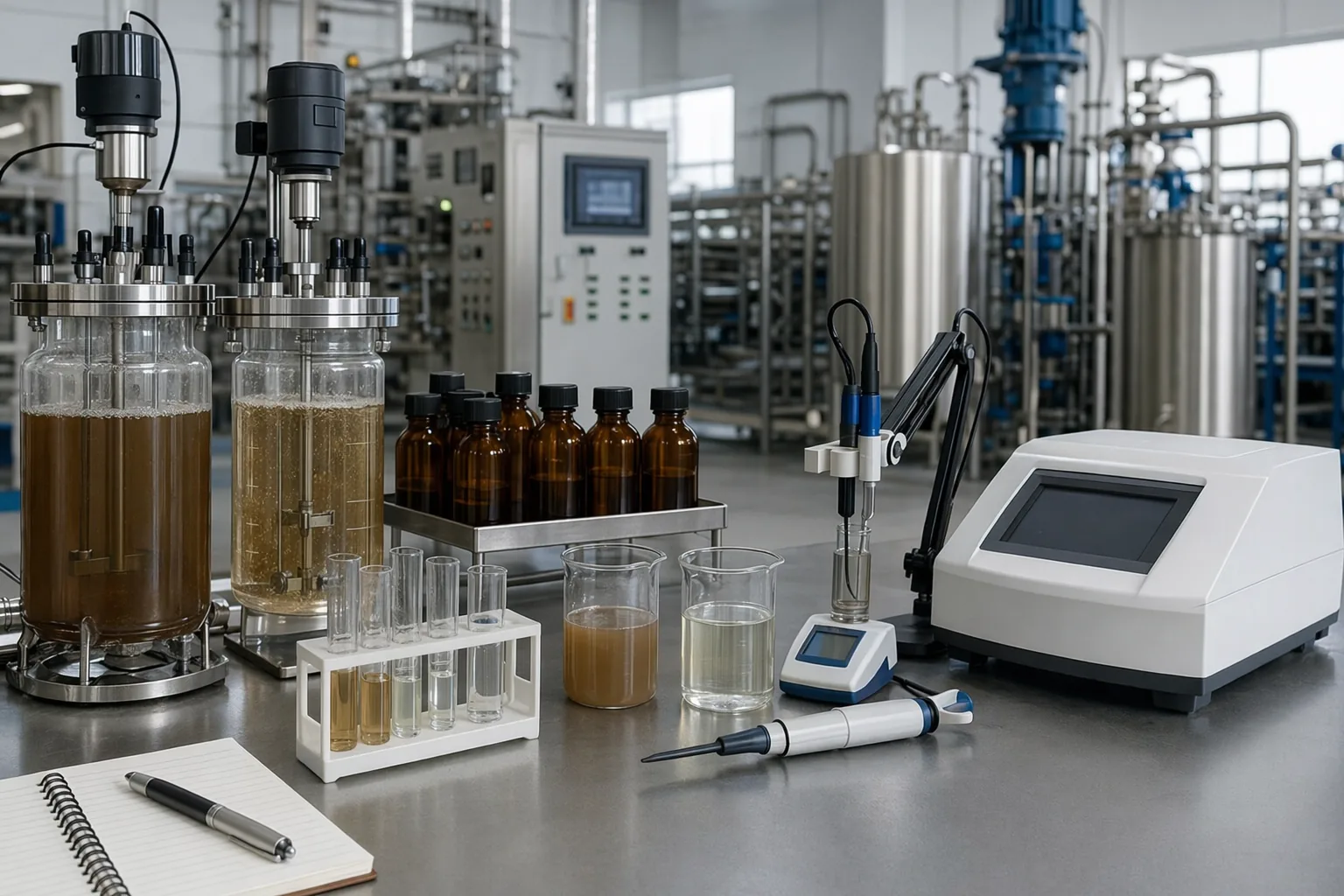
Use a defensible laccase enzyme assay to compare suppliers, set pilot dosing, and control enzyme activity before scaling oxidative wastewater treatment.
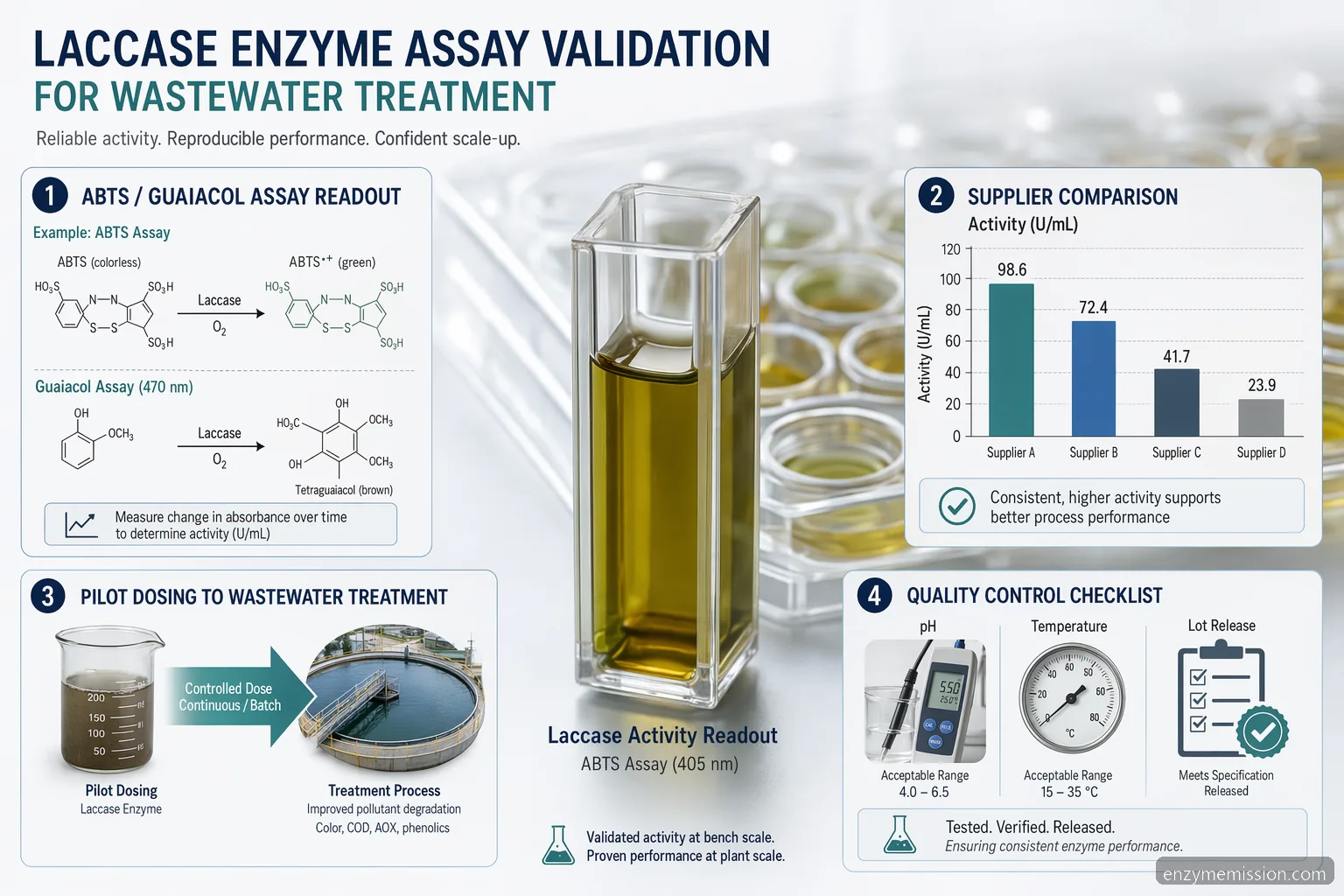
Why the Assay Matters Before Buying Laccase
A laccase enzyme assay is the starting point for comparing commercial laccase enzyme options for wastewater treatment, pulp bleaching, and bioremediation. For industrial buyers, the assay is not just a lab number; it determines how many active units are delivered per kilogram, how dosage is calculated, and whether a batch meets the agreed specification. Laccase activity can vary significantly with assay substrate, pH, buffer, temperature, and reaction time, so two products may not be directly comparable unless the laccase enzyme assay protocol is aligned. In wastewater applications, the enzyme must perform in real effluent containing salts, surfactants, dyes, phenolics, metals, and variable pH. A reliable procurement process links the supplier’s release assay to a site-specific jar test or pilot trial, then converts enzyme activity into cost-in-use per cubic meter treated.
Confirm the unit definition used on the COA. • Ask whether activity is measured by ABTS, guaiacol, or another substrate. • Compare products on delivered active units, not only price per kilogram. • Validate performance in actual wastewater, not only clean buffer.
Common ABTS and Guaiacol Assay Conditions
The most common laboratory methods are laccase enzyme assay using ABTS and laccase enzyme assay using guaiacol. ABTS is highly sensitive and is often run in acetate or citrate buffer around pH 3.0 to 5.0, with absorbance monitored near 420 nm after oxidation. Guaiacol assays are frequently run around pH 5.0 to 6.0, with oxidation followed near 465 to 470 nm. Typical assay temperatures are 25 to 40 °C, but the exact temperature must be stated because laccase enzyme activity assay values rise or fall with thermal conditions. For purchasing, do not mix values from a laccase enzyme assay ABTS method with values from a guaiacol method unless a supplier provides a validated correlation. The release method should be documented, repeatable, and suitable for incoming QC.
ABTS: useful for sensitive activity screening. • Guaiacol: useful for routine comparative checks where validated. • Always state buffer, pH, temperature, wavelength, and reaction time. • Use the same assay for incoming batch comparisons.
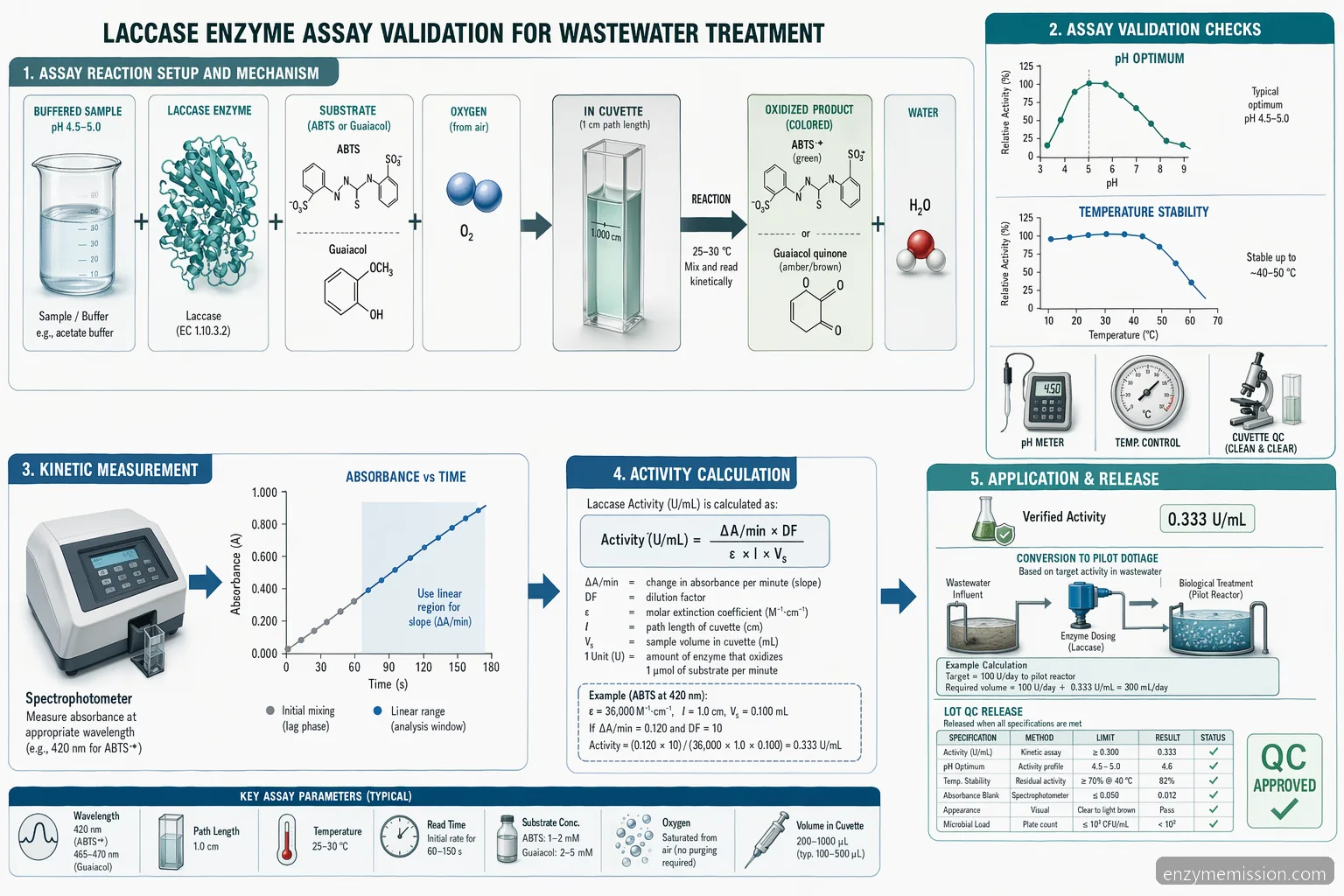
Translating Assay Units to Wastewater Dosage
Assay activity does not automatically predict field performance, so dosage must be confirmed through jar tests and pilot validation. A practical screening range for laccase wastewater trials may start at 5 to 100 U/L for low-strength streams and extend to 100 to 1,000 U/L for difficult color, phenolic, or lignin-derived effluent, depending on contact time and contaminant load. Many laccases operate best under mildly acidic conditions, often pH 4.0 to 6.5, though some formulations tolerate near-neutral wastewater. Typical process temperatures for trials are 20 to 45 °C. Contact time may range from 30 minutes to several hours. Buyers should evaluate whether pH adjustment, aeration, filtration, or mediator chemistry is economically acceptable. The best laccase enzyme assay protocol supports these decisions by connecting activity, dosage, reaction time, and removal performance.
Start with jar tests before committing to bulk supply. • Track pH drift, temperature, dissolved oxygen, and conductivity. • Calculate cost per cubic meter treated at the target endpoint. • Confirm whether pre-filtration improves enzyme efficiency.
QC Checks for Pilot and Production Lots
A B2B laccase program should include incoming QC, storage control, and performance checks against agreed acceptance criteria. At minimum, the supplier should provide a COA showing activity, lot number, manufacture or retest date, appearance, and any relevant microbiological or contaminant limits for the product type. The TDS should describe recommended pH, temperature, handling, solubility, storage, and application guidance. The SDS should cover occupational handling, dust or aerosol precautions, spill response, and transport information. In-house QC can repeat the selected laccase enzyme activity assay, then verify wastewater performance using a standard site sample. Record absorbance change, color removal, phenolic reduction, COD trend, residual activity, and any impact on downstream biological treatment or sludge generation.
Request COA, TDS, and SDS before pilot purchase. • Retain lot samples for investigation and comparison. • Use refrigerated or dry storage only when specified by the supplier. • Set acceptance limits before the first production-scale delivery.
Supplier Qualification and Cost-in-Use
Supplier qualification should go beyond a quoted activity number. Ask for the exact laccase enzyme assay protocol used for release, expected lot-to-lot variation, shelf-life conditions, formulation type, and technical support available during pilot work. For wastewater treatment, the winning enzyme is the one that meets discharge or pretreatment goals at the lowest validated cost-in-use, not necessarily the one with the highest stated activity. Include chemical savings, reduced color surcharge, lower downstream treatment load, pH adjustment, contact tank requirements, and disposal effects in the calculation. If multiple suppliers use different assays, request side-by-side testing under one internal method. A qualified supplier should support sample evaluation, scale-up recommendations, realistic dosage bands, and documentation without making unsupported claims about universal removal performance.
Compare total treatment economics, not only enzyme price. • Check supply reliability, lead time, packaging, and batch traceability. • Require application data relevant to wastewater, pulp, lignin, or dyes. • Confirm technical support for troubleshooting at pilot scale.
Technical Buying Checklist
Buyer Questions
There is no single best assay for every project. ABTS is sensitive and useful for screening, while guaiacol can be practical for routine QC when validated. For wastewater treatment, the chosen laccase enzyme assay should be consistent, documented, and linked to performance in actual effluent. Buyers should require the supplier’s protocol and then confirm dosage through site-specific jar tests.
Direct comparison is not recommended unless a validated correlation exists for the same enzyme product. A laccase enzyme assay using ABTS and a laccase enzyme assay using guaiacol differ in substrate chemistry, pH, wavelength, sensitivity, and response. For procurement, compare competing products with one internal method or require suppliers to report activity under the same agreed conditions.
A practical starting screen is about 5 to 100 U/L for lower-strength wastewater and 100 to 1,000 U/L for streams with difficult color, phenolics, lignin derivatives, or dye load. The correct dosage depends on pH, temperature, contact time, oxygen, inhibitors, and treatment target. Pilot data should be converted into cost-in-use per cubic meter before purchase approval.
A qualified supplier should provide a COA, TDS, SDS, and the laccase enzyme assay protocol used for batch release. The COA should identify lot activity and traceability. The TDS should explain handling, storage, pH, temperature, and application guidance. The SDS should support safe industrial handling. Buyers should also request stability data and pilot-scale technical support.
Assay activity helps calculate delivered active units, but cost-in-use depends on actual treatment performance. A high-activity product may still be uneconomical if it requires heavy pH adjustment, long contact time, or high dosage in real wastewater. Compare enzymes by pilot-validated removal results, chemical savings, operating changes, and total cost per cubic meter treated.
Laccase for Research & Industry
Need Laccase for your lab or production process?
ISO 9001 certified · Food-grade & research-grade · Ships to 80+ countries
Frequently Asked Questions
What is the best laccase enzyme assay for wastewater projects?
There is no single best assay for every project. ABTS is sensitive and useful for screening, while guaiacol can be practical for routine QC when validated. For wastewater treatment, the chosen laccase enzyme assay should be consistent, documented, and linked to performance in actual effluent. Buyers should require the supplier’s protocol and then confirm dosage through site-specific jar tests.
Can I compare ABTS and guaiacol activity values directly?
Direct comparison is not recommended unless a validated correlation exists for the same enzyme product. A laccase enzyme assay using ABTS and a laccase enzyme assay using guaiacol differ in substrate chemistry, pH, wavelength, sensitivity, and response. For procurement, compare competing products with one internal method or require suppliers to report activity under the same agreed conditions.
What dosage should be used in a laccase wastewater pilot?
A practical starting screen is about 5 to 100 U/L for lower-strength wastewater and 100 to 1,000 U/L for streams with difficult color, phenolics, lignin derivatives, or dye load. The correct dosage depends on pH, temperature, contact time, oxygen, inhibitors, and treatment target. Pilot data should be converted into cost-in-use per cubic meter before purchase approval.
What documents should an industrial laccase supplier provide?
A qualified supplier should provide a COA, TDS, SDS, and the laccase enzyme assay protocol used for batch release. The COA should identify lot activity and traceability. The TDS should explain handling, storage, pH, temperature, and application guidance. The SDS should support safe industrial handling. Buyers should also request stability data and pilot-scale technical support.
How does assay activity affect cost-in-use?
Assay activity helps calculate delivered active units, but cost-in-use depends on actual treatment performance. A high-activity product may still be uneconomical if it requires heavy pH adjustment, long contact time, or high dosage in real wastewater. Compare enzymes by pilot-validated removal results, chemical savings, operating changes, and total cost per cubic meter treated.
Related: Laccase for Industrial Oxidation Jobs
Turn This Guide Into a Supplier Brief Request a laccase enzyme assay review and wastewater pilot plan for your effluent stream. See our application page for Laccase for Industrial Oxidation Jobs at /applications/laccase-enzyme-price-india/ for specs, MOQ, and a free 50 g sample.
Contact Us to Contribute