Laccase Enzyme Production From Bacteria: Process Guide
Guide to bacterial laccase enzyme production, QC, scale-up, cost-in-use, and supplier qualification for industrial buyers.
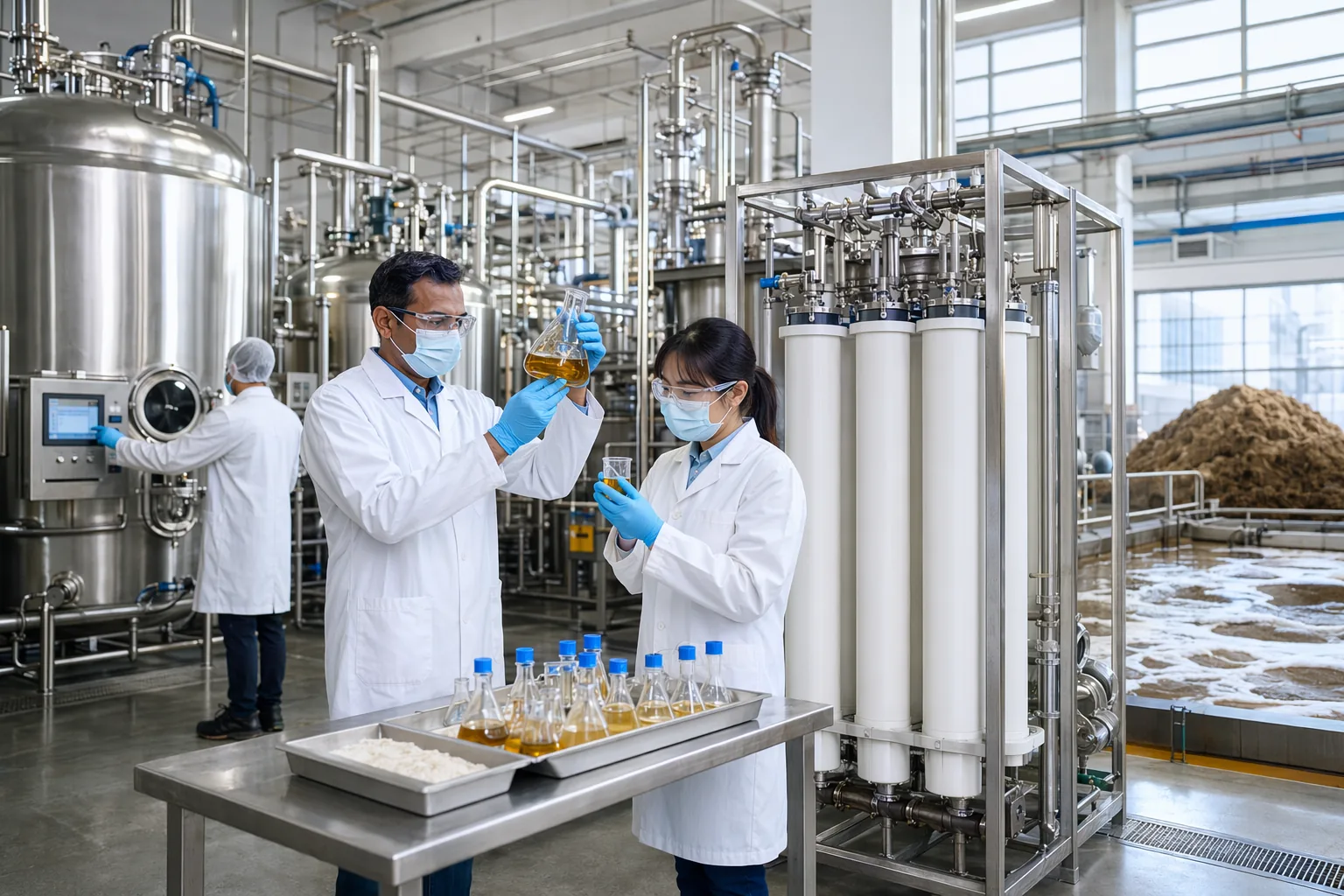
A practical B2B guide for sourcing, validating, and scaling bacterial laccase for wastewater treatment, pulp bleaching, lignin modification, and bioremediation.
Why Bacterial Laccase Matters for Industrial Buyers
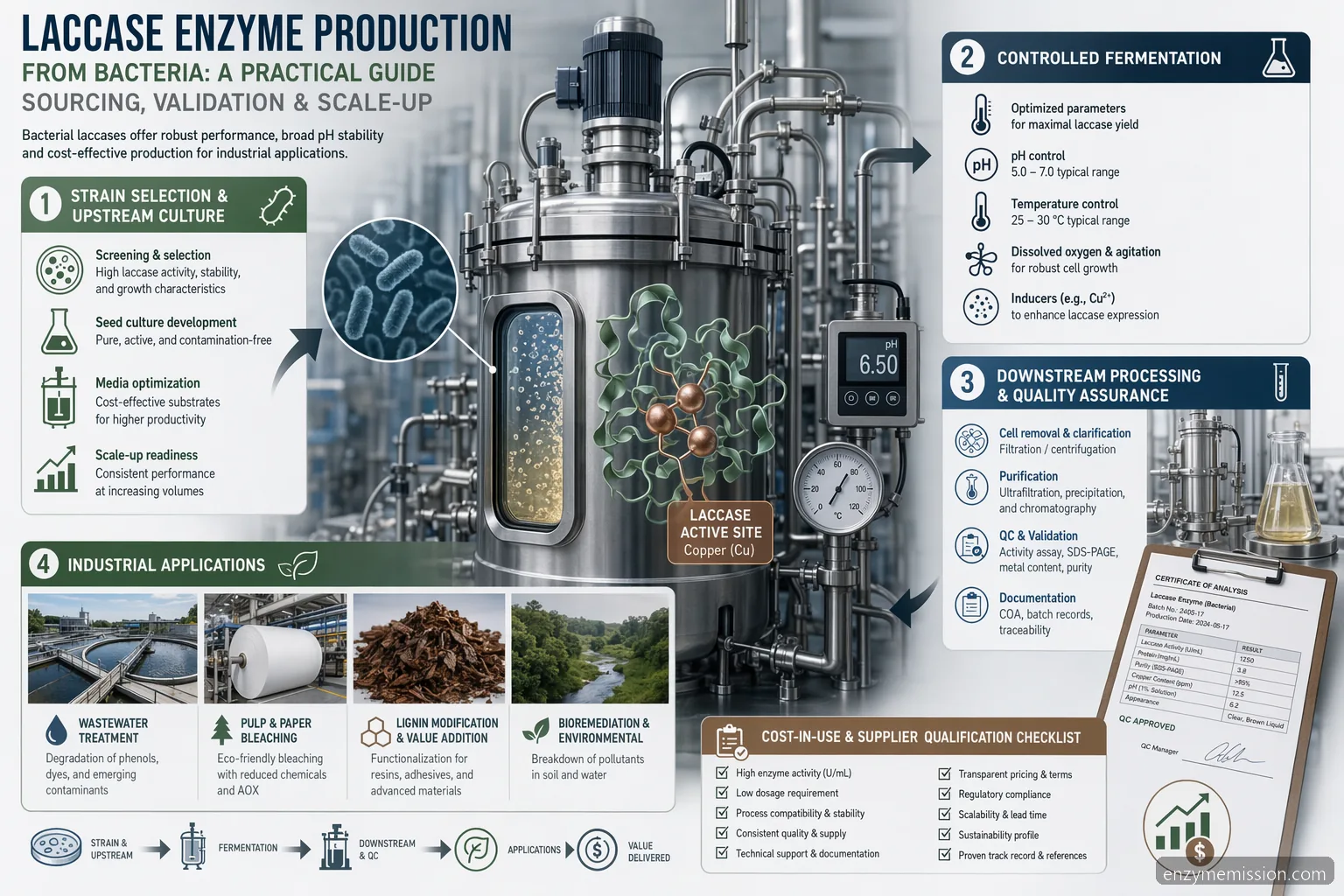
Laccase enzyme production from bacteria is increasingly considered where buyers need oxidative biocatalysis that can tolerate broader operating windows than many traditional fungal enzymes. A laccase enzyme from bacteria may show useful stability at neutral to alkaline pH, moderate process temperatures, and variable ionic strength, depending on the strain and formulation. This makes bacterial laccase relevant for laccase wastewater treatment, pulp bleaching support, lignin modification, dye decolorization, and bioremediation workflows. For procurement teams, the critical question is not only whether the enzyme works in a model assay, but whether it performs in the actual industrial matrix. Real streams may contain surfactants, phenolics, salts, metals, residual oxidants, or suspended solids. The right sourcing process therefore combines technical datasheets, representative samples, pilot trials, and cost-in-use modeling before long-term supply approval.
Best suited for oxidative treatment of phenolics, dyes, lignin-derived compounds, and similar substrates. • Performance depends strongly on pH, temperature, oxygen availability, inhibitors, and mediator strategy. • Industrial value should be judged by treated volume, reduced chemical use, or improved process efficiency.
Core Production Process for Bacterial Laccase
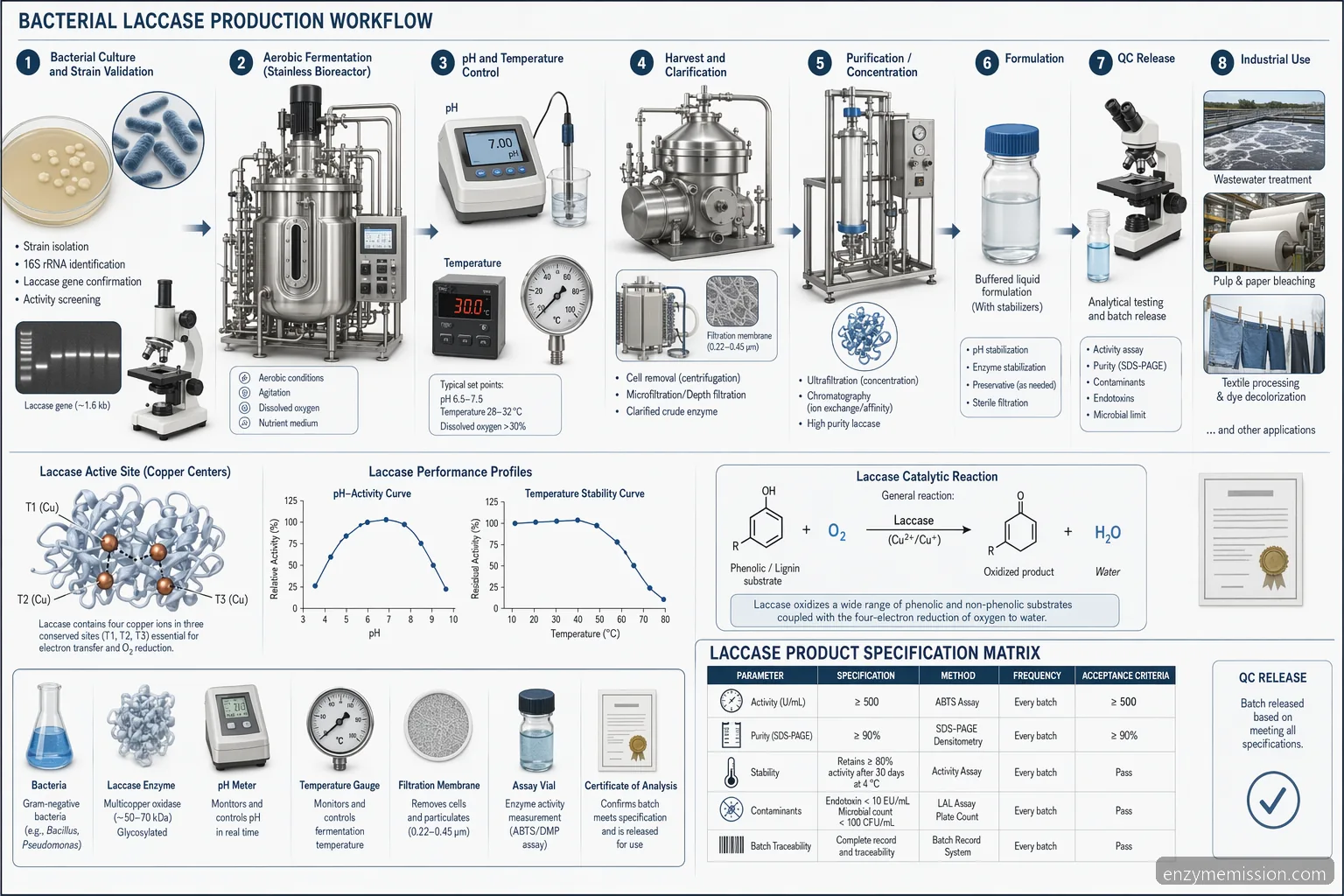
The production of laccase enzyme from bacteria usually begins with screening laccase enzyme producing bacteria, followed by fermentation optimization and downstream stabilization. Common development variables include carbon source, nitrogen source, trace copper level, dissolved oxygen, pH, temperature, and induction timing. Lab and pilot fermentations often run near pH 6.0–8.5 and 25–37°C, although the optimum depends on the organism and target enzyme. Aeration may be evaluated around 0.5–1.5 vvm, with agitation adjusted to maintain oxygen transfer without excessive shear or foaming. Copper salts are frequently studied as inducers, often in low millimolar or sub-millimolar ranges, but residual metal limits and wastewater discharge requirements must be considered. After fermentation, the broth may be clarified, concentrated, filtered, and formulated as liquid or powder for shipping stability.
Optimize induction level against yield, residual copper, and regulatory limits. • Track dissolved oxygen because laccase catalysis and production are oxygen-sensitive. • Use pilot broth handling studies to confirm filtration, concentration, and stability behavior.
Bacterial Versus Fungal Laccase Production
Laccase enzyme production from fungi is well established and can deliver high activity under acidic conditions, especially for lignocellulosic or dye-related applications. However, bacterial systems may offer advantages where process pH is neutral to alkaline, where thermal tolerance is required, or where faster growth and simpler genetic handling are useful during development. Buyers comparing laccase enzyme production from fungi with bacterial routes should avoid assuming that one source is universally better. Activity assay conditions can differ, and a high unit value in an acidic assay may not translate to alkaline wastewater or pulp conditions. Teams evaluating production and purification of laccase enzyme through fungi should request the same documentation expected for bacterial products: assay method, substrate used, unit definition, pH-temperature activity curve, stability data, and application trial results. A direct pilot comparison on the buyer’s own matrix is the most reliable decision point.
Fungal laccases are often strong candidates for acidic lignin and dye applications. • Bacterial laccases may be preferred for neutral or alkaline industrial streams. • Always compare enzymes under the intended process pH, temperature, and contact time.
Application Conditions: Wastewater, Pulp, and Lignin
In wastewater treatment, bacterial laccase is commonly evaluated for phenolic compounds, textile dyes, endocrine-active organics, and lignin-derived color bodies. Initial screening may use 10–200 U/L, with contact times of 30 minutes to several hours, then refine dosage by COD, color, target compound removal, and sludge impact. For pulp bleaching support, laccase is often assessed around pH 5.0–8.0 and 30–60°C, with dosage bands such as 5–50 U/g oven-dry pulp depending on pulp type, mediator use, and brightness goals. For laccase lignin applications, dosage may be expressed as U/g lignin or U/g dry solids, with oxygen transfer and mixing strongly affecting results. These are starting ranges, not guarantees. Final operating windows should be set by pilot validation using the buyer’s real stream, expected residence time, and downstream compatibility requirements.
Wastewater trials should measure color, COD, target pollutants, toxicity indicators, and enzyme quenching. • Pulp trials should track brightness, kappa number, viscosity, strength, and chemical savings. • Lignin trials should monitor molecular weight shift, phenolic hydroxyl change, viscosity, and filterability.
Quality Control and Product Documentation
A serious industrial laccase supplier should provide a COA for each batch, a TDS describing application guidance, and an SDS for safe handling. The COA should state enzyme activity, assay substrate, assay pH and temperature, unit definition, appearance, lot number, manufacturing date, recommended storage, and shelf-life basis. Depending on use, buyers may also request protein content, moisture, pH, density, microbial limits, heavy metals, residual copper, preservative information, and stability after freeze-thaw or warm storage. QC should include activity retention at relevant pH and temperature, not only a standard bench assay. For liquid products, viscosity, sedimentation, and bioburden control matter during storage and dosing. For powders, dust control, solubility, flowability, and moisture sensitivity should be reviewed before plant-scale handling.
Request the exact assay method and unit definition before comparing suppliers. • Confirm storage temperature, shelf life, and activity retention after shipping. • Review SDS handling precautions for powders, aerosols, preservatives, and process exposure.
Supplier Qualification and Cost-in-Use
Production and industrial applications of laccase enzyme require more than a sample that performs in a beaker test. Buyers should qualify suppliers on technical support, batch consistency, scale capacity, documentation quality, lead time, packaging, and change-control communication. Cost-in-use should include enzyme dose, activity delivered to the process, dilution or preparation labor, dosing equipment, storage losses, mediator costs if used, treatment time, reduced chemicals, improved compliance, and downstream effects. A lower-priced drum may be more expensive if activity declines in storage or if higher dosage is needed under real pH and temperature. Before commercial adoption, run a staged validation: bench screen, pilot trial, plant trial, then supply agreement. Include acceptance criteria such as activity range, impurity limits, delivery format, replacement policy for off-spec material, and technical response time.
Compare total treated volume or product output per activity unit. • Include mediator, oxygen, mixing, and pH adjustment costs in the model. • Require lot-to-lot data before locking a production-scale specification.
Technical Buying Checklist
Buyer Questions
The main advantage is the potential for laccase enzymes that operate under industrially useful conditions, including neutral to alkaline pH, moderate temperatures, and variable salt levels. This can be valuable in wastewater treatment, pulp processing, and lignin modification. The advantage is product-specific, so buyers should confirm performance with activity curves, stability data, and pilot testing on their own process stream.
Laccase enzyme production from fungi is often associated with strong acidic activity and mature fermentation know-how. Bacterial laccase production may offer different pH stability, faster organism growth, or better fit for alkaline processes. Neither route is automatically superior. Buyers should compare both using the same application conditions, including pH, temperature, inhibitors, solids, contact time, and required treatment outcome.
A practical first screen may evaluate 10–200 U/L, but the correct dose depends on contaminant type, COD load, color, pH, salts, inhibitors, oxygen transfer, and target removal. Some streams may need mediators or pretreatment, while others may respond at lower dosages. Use bench testing to identify a range, then confirm cost-in-use through pilot validation with real wastewater.
At minimum, request a COA, TDS, and SDS. The COA should include activity, assay method, unit definition, appearance, batch number, manufacturing date, storage recommendation, and shelf-life basis. The TDS should describe application guidance and operating ranges. Depending on the process, buyers may also request residual metals, microbial limits, stability data, and lot-to-lot consistency information.
Compare cost-in-use, not only price per kilogram or liter. The useful metric is the cost to achieve the required process result, such as color reduction, phenolic removal, pulp brightness, or lignin modification. Include delivered activity, dosage, storage losses, mediator cost, mixing and oxygen needs, contact time, labor, waste impact, and reliability of supply across production batches.
Laccase for Research & Industry
Need Laccase for your lab or production process?
ISO 9001 certified · Food-grade & research-grade · Ships to 80+ countries
Frequently Asked Questions
What is the main advantage of laccase enzyme production from bacteria?
The main advantage is the potential for laccase enzymes that operate under industrially useful conditions, including neutral to alkaline pH, moderate temperatures, and variable salt levels. This can be valuable in wastewater treatment, pulp processing, and lignin modification. The advantage is product-specific, so buyers should confirm performance with activity curves, stability data, and pilot testing on their own process stream.
How is bacterial laccase production different from fungal laccase production?
Laccase enzyme production from fungi is often associated with strong acidic activity and mature fermentation know-how. Bacterial laccase production may offer different pH stability, faster organism growth, or better fit for alkaline processes. Neither route is automatically superior. Buyers should compare both using the same application conditions, including pH, temperature, inhibitors, solids, contact time, and required treatment outcome.
What dosage should be used for laccase wastewater treatment trials?
A practical first screen may evaluate 10–200 U/L, but the correct dose depends on contaminant type, COD load, color, pH, salts, inhibitors, oxygen transfer, and target removal. Some streams may need mediators or pretreatment, while others may respond at lower dosages. Use bench testing to identify a range, then confirm cost-in-use through pilot validation with real wastewater.
What documents should a laccase enzyme supplier provide?
At minimum, request a COA, TDS, and SDS. The COA should include activity, assay method, unit definition, appearance, batch number, manufacturing date, storage recommendation, and shelf-life basis. The TDS should describe application guidance and operating ranges. Depending on the process, buyers may also request residual metals, microbial limits, stability data, and lot-to-lot consistency information.
How should buyers compare prices for industrial laccase enzyme?
Compare cost-in-use, not only price per kilogram or liter. The useful metric is the cost to achieve the required process result, such as color reduction, phenolic removal, pulp brightness, or lignin modification. Include delivered activity, dosage, storage losses, mediator cost, mixing and oxygen needs, contact time, labor, waste impact, and reliability of supply across production batches.
Related: Laccase for Industrial Oxidation Jobs
Turn This Guide Into a Supplier Brief Request a bacterial laccase sample, COA/TDS/SDS review, and pilot-trial support for your industrial process. See our application page for Laccase for Industrial Oxidation Jobs at /applications/laccase-enzyme-price-india/ for specs, MOQ, and a free 50 g sample.
Contact Us to Contributehello@mail.enzymemission.com