Laccase Enzyme for Industrial Wastewater Treatment
Source laccase enzyme for wastewater treatment with practical specs, dosing, assays, COA/TDS/SDS checks, pilot validation, and cost-in-use guidance.
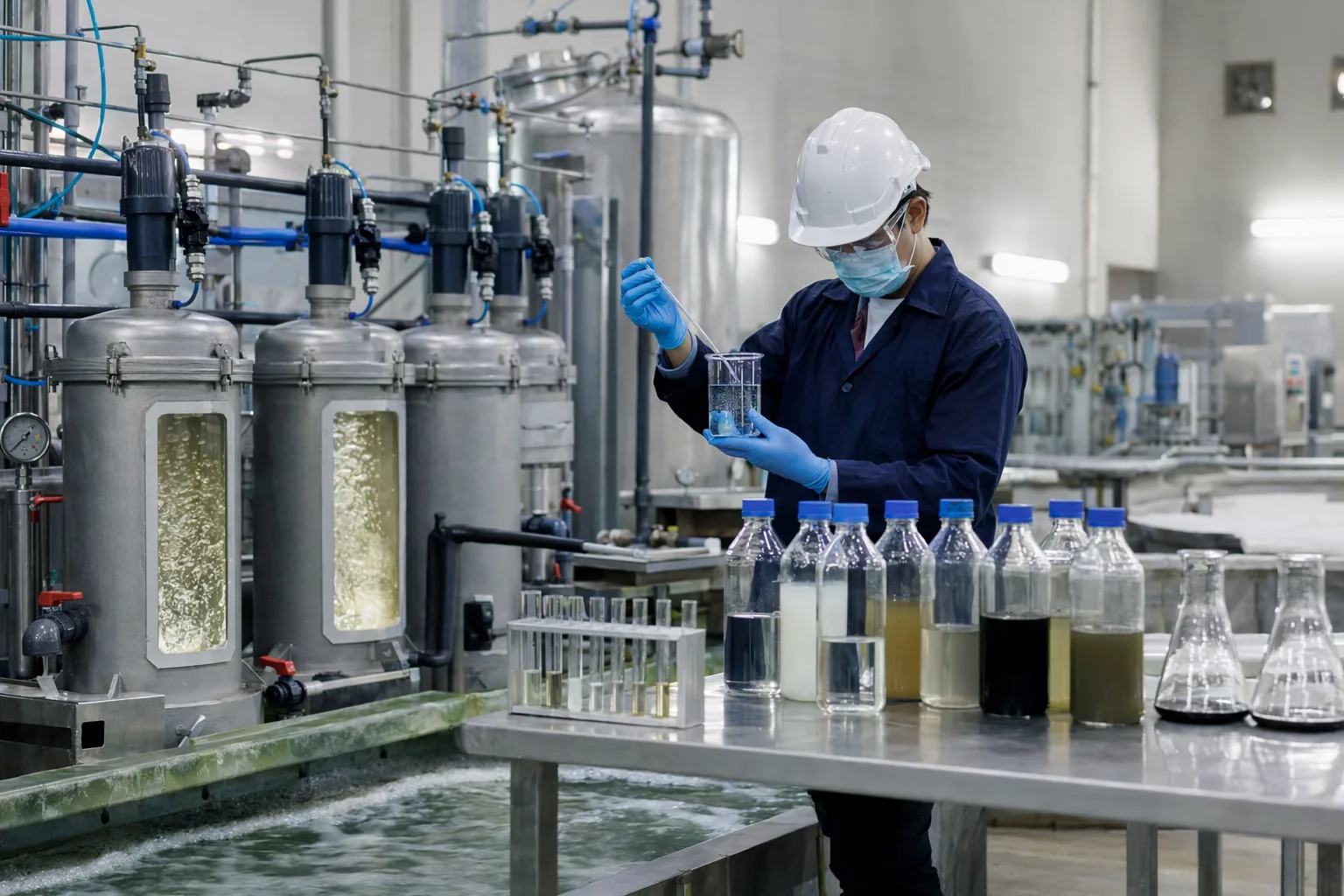
A practical buyer guide for selecting, qualifying, and piloting laccase enzyme in textile, dye, pulp, phenolic, and mixed industrial wastewater applications.
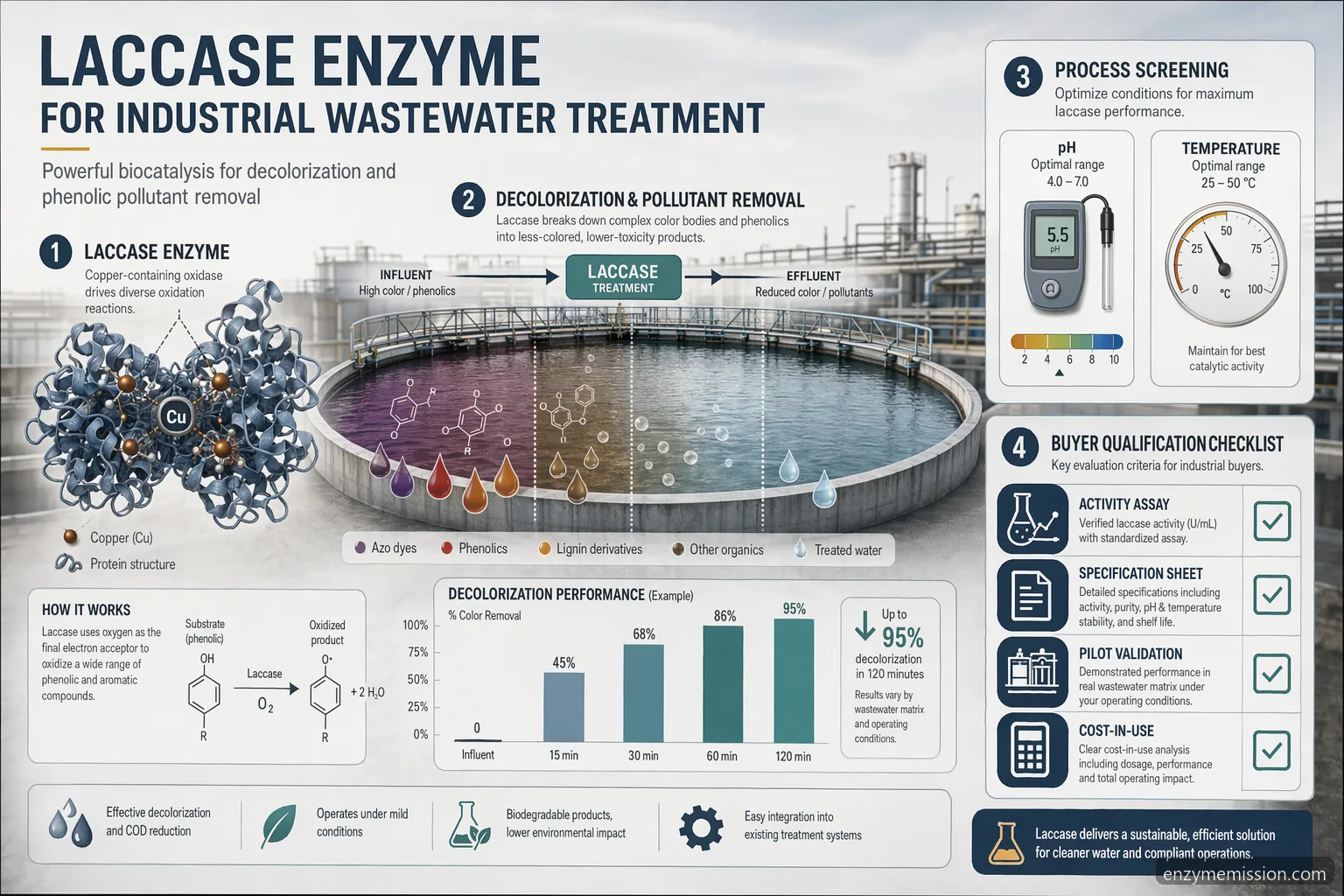
Why Buyers Evaluate Laccase for Wastewater
Laccase is a multicopper oxidase used in industrial oxidation reactions where oxygen acts as the terminal electron acceptor. In wastewater treatment, buyers often assess laccase enzyme for color reduction, phenolic compound transformation, lignin-related COD polishing, and support of bioremediation programs. It is especially relevant for textile dye effluent, pulp and paper wastewater, resin and chemical processing streams, and other waters containing oxidizable aromatic compounds. The laccase enzyme function is not a universal COD remover; performance depends on the contaminant profile, wastewater matrix, residence time, and whether mediators are needed. A strong supplier discussion should begin with influent data, treatment objective, discharge target, and existing process steps such as equalization, biological treatment, dissolved air flotation, or advanced oxidation. For B2B buyers, the goal is not simply to purchase enzyme laccase, but to confirm measurable value in a validated process window.
Best fit: phenols, selected dyes, lignin-derived compounds, and color bodies • Common targets: decolorization, toxicity reduction, and polishing after primary treatment • Key limitation: results vary by effluent composition and inhibitor load
Practical Process Conditions for Initial Screening
For early lab trials, laccase enzyme is commonly screened across pH 4.0 to 7.0, with many fungal laccases showing stronger activity in mildly acidic ranges. Temperature screening often starts at 25 to 50°C, while longer retention systems may favor lower temperatures to preserve enzyme stability. Dose bands vary widely, but bench work may begin around 10 to 200 U/L of wastewater, then adjust based on color removal, phenolic reduction, or COD response. Adequate dissolved oxygen, mixing, and contact time are important because laccase activity is oxidative. Some wastewaters benefit from redox mediators, but mediator choice must be evaluated for cost, safety, discharge compatibility, and downstream impact. Before scale-up, test salt, surfactants, heavy metals, oxidants, reducing agents, and pH swings because these can suppress laccase enzyme activity.
Starting pH screen: 4.0, 5.0, 6.0, and 7.0 • Starting temperature screen: 25, 35, 45, and 50°C • Initial dose range: 10 to 200 U/L, then optimize by cost-in-use • Monitor oxygen, mixing, retention time, and inhibitor sensitivity
Specifications Buyers Should Request
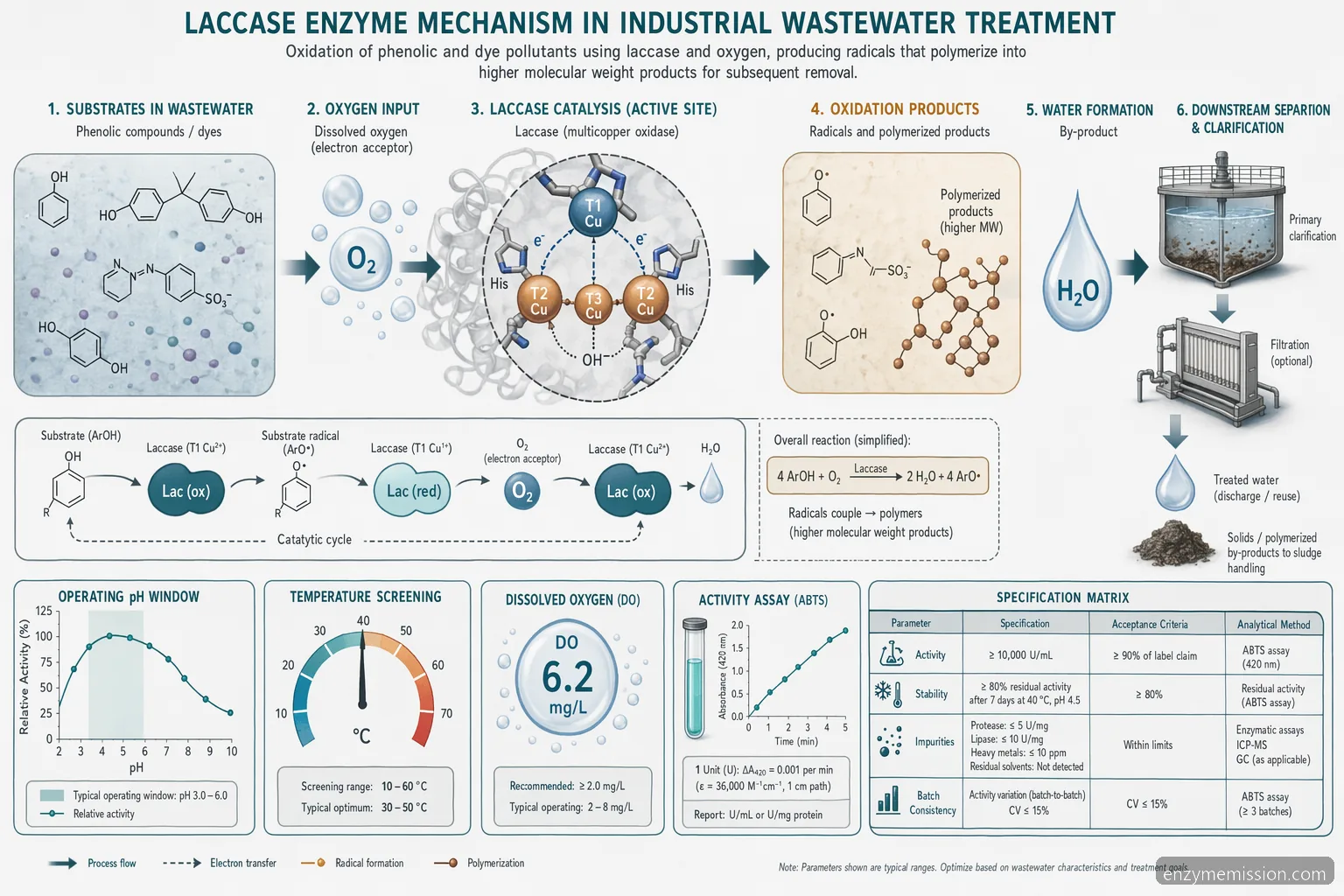
Industrial buyers should request a current COA, TDS, and SDS before commercial evaluation. The COA should state laccase enzyme activity, assay method, lot number, manufacturing date, recommended storage, and specification limits. The TDS should describe formulation type, carrier, solubility or dispersibility, recommended pH and temperature range, and handling guidance. The SDS should address storage, spill response, dust or aerosol exposure, and safe handling requirements for plant personnel. Ask whether the laccase enzyme assay is based on ABTS, guaiacol, syringaldazine, or another substrate, because activity units are not always interchangeable across assay methods. Buyers comparing laccase enzyme price should normalize by usable activity, stability in the actual effluent, shipping requirements, shelf life, and dosing efficiency. Supplier qualification should include batch consistency, technical support, documentation quality, and ability to support pilot troubleshooting.
Request COA, TDS, SDS, sample label, and recommended storage conditions • Confirm assay substrate, pH, temperature, and unit definition • Compare usable activity, not headline activity alone • Evaluate documentation speed, technical response, and batch traceability
Quality Control and Activity Assay Considerations
A laccase enzyme activity assay should be selected and repeated consistently during supplier screening, incoming QC, and pilot monitoring. ABTS-based assays are common because they are sensitive and convenient, but results depend on buffer, pH, temperature, wavelength, extinction coefficient, and reaction time. If your site uses a different laccase enzyme assay than the supplier, run a correlation study rather than assuming direct equivalence. For wastewater projects, analytical QC should pair enzyme activity with application endpoints such as color units, UV-visible spectra, phenol index, COD, TOC, toxicity indicators, sludge behavior, and downstream biological performance. Check retained activity after exposure to real wastewater for 1, 4, 8, and 24 hours. Also evaluate storage stability after shipping and under plant conditions. Strong QC prevents a low laccase enzyme price from becoming expensive through overdosing, inconsistent performance, or poor shelf-life control.
Use one validated activity method for lot-to-lot comparison • Correlate enzyme units with actual wastewater treatment outcomes • Test retained activity in real wastewater, not only clean buffer • Include shelf-life and temperature excursion checks
Pilot Validation, Scale-Up, and Cost-in-Use
A pilot program should translate bench results into a realistic plant operating model. Start with representative composite wastewater, then test enzyme laccase dose, pH adjustment, contact time, oxygen transfer, mixing intensity, and any mediator strategy. For continuous systems, evaluate hydraulic retention time and enzyme addition points, such as equalization tanks, polishing reactors, or side-stream treatment. For batch systems, confirm cycle time, mixing energy, and post-treatment compatibility. Cost-in-use should include laccase enzyme price, dosage, activity retention, pH chemicals, mediators if used, energy, labor, analytical testing, storage, and waste handling. Compare this total against alternative or complementary treatments such as adsorption, coagulation, ozone, Fenton chemistry, or membrane polishing. Before commercial supply, qualify the supplier on documentation, lead time, packaging, batch consistency, sample support, and technical ability to help troubleshoot scale-up.
Use representative composite samples across production variability • Calculate cost per treated cubic meter, not cost per kilogram • Validate enzyme addition point and retention time under plant conditions • Confirm supplier capacity, lead time, packaging, and technical support
Laccase Structure, Production, and Application Fit
Understanding laccase enzyme structure helps explain both its usefulness and its limits. Laccases contain copper centers that enable one-electron oxidation of suitable substrates while reducing oxygen to water. This structure supports reactions with phenolic compounds and, with suitable mediators, some non-phenolic compounds. Commercial production of laccase enzyme is commonly associated with microbial fermentation, followed by downstream processing into liquid or powder formulations. The chosen formulation should match the plant’s dosing equipment, storage conditions, and safety practices. For wastewater treatment, laccase should be evaluated as a process aid within a treatment train, not as a stand-alone guarantee. It may complement biological treatment, pulp bleaching effluent management, bioremediation polishing, or color reduction programs. The right fit is confirmed by measurable removal targets, stable activity, manageable cost-in-use, and compliance with site-specific operating and discharge requirements.
Laccase enzyme structure contains copper centers involved in oxidation • Commercial supply is typically fermentation-derived • Liquid and powder formats should be matched to plant handling systems • Application fit must be confirmed with wastewater-specific data
Technical Buying Checklist
Buyer Questions
The main laccase enzyme function is oxidative transformation of suitable organic compounds, especially phenols, selected dyes, and lignin-derived aromatics. In wastewater treatment, this can support decolorization, phenolic reduction, and polishing after primary or biological treatment. It should be validated against site-specific targets because laccase does not remove every contaminant and performance depends on pH, temperature, oxygen, inhibitors, contact time, and wastewater chemistry.
Compare laccase enzyme price by cost-in-use, not just cost per kilogram or liter. Normalize offers by declared activity, assay method, retained activity in your wastewater, dosage required, shelf life, freight, storage, packaging, and technical support. A higher-priced product may be more economical if it works at lower dose, remains active longer, reduces chemical use, or delivers more consistent treatment results during pilot operation.
Common laccase enzyme activity assay methods use substrates such as ABTS, guaiacol, or syringaldazine. The best QC method is the one defined consistently for supplier comparison, incoming inspection, and retained-activity testing. Always record buffer, pH, temperature, wavelength, extinction coefficient, and reaction time. Because activity units can differ by method, correlate assay results with application endpoints such as color reduction or phenol removal.
It may be suitable, but it must be tested. High salts, metals, surfactants, residual oxidants, reducing agents, and solvents can reduce laccase enzyme activity. Mixed industrial effluent also changes over time, so use composite samples and test retained activity after realistic exposure periods. Pilot trials should include worst-case production days, pH variability, and downstream compatibility before committing to commercial dosing.
A qualified supplier should provide a COA, TDS, and SDS for the laccase enzyme. The COA should include lot-specific activity and assay details. The TDS should describe formulation, recommended conditions, storage, and handling. The SDS should cover safe industrial use. Buyers should also request shelf-life guidance, packaging information, sample traceability, and technical support for bench and pilot validation.
Production of laccase enzyme affects consistency, impurity profile, formulation options, lead time, and scalability. Commercial laccase is typically produced by microbial fermentation and then processed into liquid or powder products. Buyers should not need proprietary manufacturing details, but they should qualify batch consistency, activity specification, documentation, supply reliability, and storage stability. These factors directly influence pilot performance and long-term treatment economics.
Laccase for Research & Industry
Need Laccase for your lab or production process?
ISO 9001 certified · Food-grade & research-grade · Ships to 80+ countries
Frequently Asked Questions
What is the main laccase enzyme function in wastewater treatment?
The main laccase enzyme function is oxidative transformation of suitable organic compounds, especially phenols, selected dyes, and lignin-derived aromatics. In wastewater treatment, this can support decolorization, phenolic reduction, and polishing after primary or biological treatment. It should be validated against site-specific targets because laccase does not remove every contaminant and performance depends on pH, temperature, oxygen, inhibitors, contact time, and wastewater chemistry.
How should buyers compare laccase enzyme price?
Compare laccase enzyme price by cost-in-use, not just cost per kilogram or liter. Normalize offers by declared activity, assay method, retained activity in your wastewater, dosage required, shelf life, freight, storage, packaging, and technical support. A higher-priced product may be more economical if it works at lower dose, remains active longer, reduces chemical use, or delivers more consistent treatment results during pilot operation.
What laccase enzyme activity assay should be used for QC?
Common laccase enzyme activity assay methods use substrates such as ABTS, guaiacol, or syringaldazine. The best QC method is the one defined consistently for supplier comparison, incoming inspection, and retained-activity testing. Always record buffer, pH, temperature, wavelength, extinction coefficient, and reaction time. Because activity units can differ by method, correlate assay results with application endpoints such as color reduction or phenol removal.
Is laccase wastewater treatment suitable for high-salt or mixed industrial effluent?
It may be suitable, but it must be tested. High salts, metals, surfactants, residual oxidants, reducing agents, and solvents can reduce laccase enzyme activity. Mixed industrial effluent also changes over time, so use composite samples and test retained activity after realistic exposure periods. Pilot trials should include worst-case production days, pH variability, and downstream compatibility before committing to commercial dosing.
What documents should a laccase enzyme supplier provide?
A qualified supplier should provide a COA, TDS, and SDS for the laccase enzyme. The COA should include lot-specific activity and assay details. The TDS should describe formulation, recommended conditions, storage, and handling. The SDS should cover safe industrial use. Buyers should also request shelf-life guidance, packaging information, sample traceability, and technical support for bench and pilot validation.
How is production of laccase enzyme relevant to purchasing?
Production of laccase enzyme affects consistency, impurity profile, formulation options, lead time, and scalability. Commercial laccase is typically produced by microbial fermentation and then processed into liquid or powder products. Buyers should not need proprietary manufacturing details, but they should qualify batch consistency, activity specification, documentation, supply reliability, and storage stability. These factors directly influence pilot performance and long-term treatment economics.
Related: Laccase for Industrial Oxidation Jobs
Turn This Guide Into a Supplier Brief Request a laccase enzyme sample, COA/TDS/SDS, and pilot support for your wastewater treatment evaluation. See our application page for Laccase for Industrial Oxidation Jobs at /applications/laccase-enzyme-price-india/ for specs, MOQ, and a free 50 g sample.
Contact Us to Contributehello@mail.enzymemission.com